Showing posts with label Umami. Show all posts

Thursday, June 9, 2011

Open Faced Steak Sandwich Topped with Sautéed Celery Root and Leeks Paired with 2006 Benziger Family Winery Sonoma County Merlot

For quite some time now, I have wanted to construct a pairing that featured pureed celery root.  Unfortunately, the celery root has not been available for several weeks (at least while I was visiting the grocery).  Well, I found celery root yesterday, and came close to making the celery root puree.  I say almost because as I looked at the stock in the fridge I found a leftover steak from the weekend grill-fest and decided to do something with it – and include the celery root.  The result was an open faced steak sandwich with a mound of sautéed celery root and leeks, oh, and a little cheese to hold the mound of flavor in place.

This wonderful little sandwich is rich in umami and layered with the aromatic celery flavors from the celery root and just a touch of piquance from the cayenne.  Warming the leftover steak in the beef broth was a key part of the process which “rehydrated” the steak and made things nice and juicy.

These flavors were joyously complimented with dark and vibrant flavors of blueberry and pepper supported by soft tannins in the 2006 Benziger Family Winery Sonoma County Merlot.  This Merlot is silky smooth and perfectly echoed the flavors in the sandwich.

2006 Benziger Family Winery Sonoma County Merlot-2

I have to admit that like the dish, the pairing was not planned in advance.  Similar to the steak, the 2006 Benziger Family Winery Sonoma County Merlot was a leftover – we tapped into this bottle the night before to enjoy just a taste of our recent shipment from Benziger Family Winery.  We joined the Benziger Family Winery wine club during our January trip to California, and were ecstatic to find this Merlot living up to the wonderful experience we had while visiting the winery in Sonoma County.  We thoroughly enjoyed every wine we tasted, and I highly recommend you give them a visit at www.benziger.com.

Recipe

Ingredients

  • 1 leftover steak sliced in to 1/4 to 1/2 inch strips
  • 1 loaf of par baked bread (or make your own from scratch)
  • 1/2 medium sized celery root coarsely grated
  • 1 leek chopped
  • 2 cups beef broth
  • 1 cup grated cheese (your choice of cheese, but I recommend something mild)
  • 1/2 teaspoon cayenne pepper
  • olive oil
  • salt and pepper to taste

Preparation

  1. Finish baking the par baked bread, in my case it was 15 minutes in a 375 degree preheated oven.
  2. Coat the bottom of a small pan with olive oil and place on medium high heat.
  3. Add leeks and cayenne pepper.  Sauté for about one minute.
  4. Add the grated celery root and sauté until tender.  Season with salt and pepper then remove from heat and set aside.
  5. If you time this right, your bread should be done now.  Remove from oven and allow to cool for a few minutes.
  6. In a medium sauce pan, bring two cups of beef broth to a simmer.  Just before you are ready to assemble the sandwich, add the steak strips to the broth and warm through.  The idea is simply to warm the meat, not cook it.
  7. Cut the bread into 1 inch or so slices.  In my case, the steak made three sandwiches which miraculously meant three slices.
  8. Assemble the sandwich by laying slices of steak across the bread, adding a stack of the celery root and leek sauté and lightly coating with grated cheese.
  9. Place the sandwiches on sheet pan and place under the broiler until the cheese melts. 1-2 minutes.
  10. Remove from broiler and plate with a small saucer of the beef broth (for dunking bread).
  11. This is somewhat of a “vertical” sandwich, so bring along a fork and knife.

My apologies for the lack of photography with this post.  It was a last minute thought and last minute happy coincidence.  However, if you give this pairing a go the next time you have a leftover steak in the fridge, I’m confident it will make up for the lack of pretty pictures.

In vino veritas, buen provecho.

Craig

Saturday, May 28, 2011

Coffee and Beer Marinated Steak with Truffle Parsnips Paired with 2004 McClean Vineyards Estate Private Reserve Paso Robles Syrah

Grilled London Broil Truffle Parsnips paired with 2004 McClean Vineyards Estate Private Reserve Paso Robles Syrah-1

Welcome to a special Memorial Day weekend edition of Craig’s Grape Adventure.  I don’t normally post on the weekend, because my handy Google Stats tell me that most of you are enjoying a bit of escapism while at work during the week.  No worries, I won’t let your little secret out.

Grilling is a time honored tradition in the U.S. over the Memorial Day weekend.  In case you have not yet completed your menu for the weekend, this pairing may provide an interesting twist on the traditional.  Chef Sue and I tested it last night with absolutely mouth watering results.

London Broil on the Grill-1

In the interest of full disclosure and appropriate credits, this recipe comes from Whats Cookin – Food With Taste.  I highly recommend you sign up for their free newsletter that conveniently shows up in your inbox twice a week with some deliciously unique recipes.  Thanks a bunch to the folks at Whats Cookin for an endless stream of inspiration.

It goes without saying that Chef Sue and I cannot take any recipe at face value.  In this case we stayed pretty true to the Whats Cookin recipe for Coffee Steaks Under the Influence, but made a few modifications mostly out of convenience and a little intuition.  Follow the link for the original recipe.  I have parenthetically noted our modifications in the recipe at the end of the post.

The Food

London Broil Plating

I was drawn to this recipe out of idle curiosity – a coffee and beer based marinade – really?  My curiosity was rewarded with a wonderful blend of flavors.  Although the marinade and the rub include a number of ingredients, the coffee was clearly the headliner.  The coffee, toasted on the surface of the steak was a perfect addition to the steak.  It was not overwhelming and added a very pleasant nutty coffee note to each bite.  This earthiness melded perfectly with the truffle parsnips chosen to fill out the plate.

The Pairing

2004 McClean Vineyards Estate Private Reserve Paso Robles Syrah-1

Normally I would discuss the wine a bit before getting to the pairing.  However, in this case I am simply too anxious to get to the heart of the matter.  The pairing was spectacular.  We have already established that the steak and parsnips feature a wonderful nutty earthiness with plenty of umami to bring smiles to the faces of even grumpy old men.  The 2004 McClean Vineyards Estate Private Reserve Paso Robles Syrah precisely complemented these flavors with deep flavors of chocolate (chocolate and coffee – YES!) plumb, and a pleasant spiciness which added a delicious peppery coating to the steak.  At $28 per bottle, this wine is well worth every penny to pair with the fruit of your grilling efforts.

The Recipe 

Coffee Steak Under the Influence

The following recipe is presented in it's original form. Chef Sue's modifications and other notes are parenthetically noted.

Grilled London Broil Truffle Parsnips paired with 2004 McClean Vineyards Estate Private Reserve Paso Robles Syrah-4

Ingredients

  • 12 ounces heavy beer. I used Yuengling Black And Tan, but any dark preferably craft beer will work.
  • 1/4 cup Worcestershire sauce
  • 1 tablespoon Crystal Hot Sauce
  • 3 boneless strip steaks (1 1/2 to 2 pounds), trimmed of fat (Chef Sue chose London Broil cut in Barney Rubble thickness - honestly, use your favorite steaks, its all good.)
  • 3 tablespoons fine ground dark roast coffee
  • 1 tablespoon pure chile powder
  • 1 teaspoon ground cumin
  • 1 teaspoon sugar
  • 1/2 teaspoon cayenne, or more to taste
  • 1 teaspoon salt
  • 1/2 teaspoon ground black pepper
  • 1 tablespoon of vegetable oil

Sliced London Broil-1

Preparation

The Night Before: Mix the beer, Worcestershire sauce and Crystal Hot Sauce in a large freezer zipper lock bag. Put the steaks in the bag, seal it shut, then refrigerate overnight. (Chef Sue combined ALL the ingredients in the marinade - they all made sense in the marinade and she could not resist the temptation. Rather than marinade overnight, Chef Sue let the steaks marinade for about 4 hours.)

Grilling Day: Mix the other ingredients in a bowl. Take the steaks out of the marinade, discarding the marinade. Pat dry the steaks with paper towels, then dampen with vegetable oil. Coat the steaks with the spicy mix, patting in gently with your fingers.

Pre-heat the grill. If you’re using a propane grill, high heat is good. Grill the steaks until they have a dark crust. Two minutes on each side for medium rare (depending on thickness of steaks). Four minutes per side for medium. (As designated grill master at our secret Potomac lair affectionately known as the Crab Shack, my grilling method is slightly different. Because we used the Barney Rubble cut (think hugely thick Brontosaurus steaks), I grilled on high heat with my tried and true process of 2.5 minutes, rotate 90 degrees for another 2.5 minutes, flip for 2.5 minutes, then rotate 90 degrees for another 2.5 minutes. This process results in those oh so beautiful grill branding marks and beautifully pink medium rare steaks. The timing is completely dependent on the steak thickness which may require some minor adjustment. Use a meat thermometer and adjust your grilling time to get an internal temperature of 130 to 140 degrees F. Legal disclaimer: USDA recommends a minimum internal temperature of 145 degrees. If grilling steak to 130 degrees is the riskiest activity in my life, I can live with that. For my palate, the more you head in the direction of well done, the greater the loss of flavor. When you remove the steak from the grill, allow to rest for 5 minutes before slicing/plating. The internal temperature will continue to rise during this resting period and the juices will redistribute throughout the steak ensuring a plump juicy piece of meat.)

Truffle Parsnips

Ingredients

  1. 4 medium parsnips (cleaned, pealed and cubed)
  2. 3 small red potatoes (cubed)
  3. 1/4 cup cream cheese
  4. 2 oz. butter
  5. Truffle salt to taste
  6. Green onions (chopped as garnish)

Preparation

  1. Boil parsnips and potatoes until fork tender.
  2. Mash parsnips and potatoes in a bowl along with the cream cheese and butter.
  3. Season with truffle salt to taste.
  4. Plate and garnish with green onions.

Enjoy your grilling, and have a great Memorial Day weekend.

In vino veritas, buen provecho.

Craig

Saturday, March 26, 2011

Pork Stuffed Pork Wrapped in Pork and Roasted Cauliflower Paired with 2009 Caretaker Pinot Noir

In my last post “Pork Stuffed Pork Wrapped in Pork” I shared some photographs of the ingredients that made up last night’s pairing.  As promised, I am back to offer you the blow-by-blow along with recipes for the menu.  Golf Buddy Steve brought the 2009 Caretaker Pinot Noir, and we were joined by Photography Buddy John.

Stuffed Pork Loin Roasted Cauliflower with 2009 Caretaker Pinot Noir-1

The Food

The pork stuffed pork wrapped in pork is a creation of my wife, Chef Sue.  For this meal, I made some modifications to Sue’s approach which resulted in some wonderful surprises, and “some opportunities for improvement.”  From the flavor perspective, my adaptation was a great success.  This comes from my use of home made sausage rather than pre-made sausage.  This gave me some control over the flavors.  My intent was to heat to balance the sweetness of the pork (particularly the bacon) and the fruit glaze that was added during the last 30 minutes in the oven.  This part worked brilliantly with one exception.  I had intended to add apple and orange to the sausage (see the photos of ingredients from “Pork Stuffed Pork Wrapped in Pork”), but somehow failed to add these important acidic and sweet components.  This was not a critical flaw, but it would have been better had I paid closer attention.

Pork Stuffed Pork Ingredients-2

The second improvement applies to the texture.  The home made pork sausage texture was not far from the pork loin texture after roasting.  Gratefully, there was a nice textural difference with the bacon.  The dish could have been improved tremendously by drawing a further distinction between the stuffing and the pork loin.  So here is my recommendation (ok, not mine – this comes from Chef Sue):  If you attempt this recipe, I would follow the directions for making the sausage.  I would then prepare some seasoned bread stuffing (make it from scratch with toasted stale bread, or Pepperidge Farm, your choice) then combine the sausage and bread stuffing with 1/3 sausage by volume and 2/3 stuffing.  Also, when you hydrate the bread stuffing, make sure you prepare it with butter (1 tablespoon per cup of dry bread crumbs) along with your broth or water – the sweetness of the butter will be a noteworthy added flavor.  The addition of the bread stuffing to the sausage will make for a layer a softer texture and therefore contrast nicely with the pork loin and the bacon.

Stuffed Pork Loin Roasted Cauliflower with 2009 Caretaker Pinot Noir-2

Like the lack of apple and orange, the textural improvement was not a critical flaw, just another opportunity to make a wonderful meal even better.

With respect to flavors, the stuffed pork loin is a matter of balance; fat balanced with the heat of the sausage, the sweetness of the bacon and fruit glaze in balance with the heat in the sausage.  The dominant taste components included sweet, umami, and piquance.  The roasted cauliflower and onion was a nice mild supporting actor for the pork.  Flavors from the cauliflower and onion were a very pleasant nuttiness that was enhanced by the roasting.  The texture was tender yet firm. 

Roasted Cauliflower and Onion

Finally, I highly recommend you try the recipe for the roasted cauliflower.  It is simple, features straight forward flavors and may win over that person in the house who is not a fan of Cauliflower (we saw exactly this happen with Photography Buddy John).

The Wine

Golf Buddy Steve brought a 2009 Caretaker Pinot Noir.  This wine has gained some notoriety through sales at Trader Joe’s.  A quick search of the web revealed our experience with this wine was consistent with all but a few who were not impressed.  Our judges for the evening enjoyed the 2009 Caretaker Pinot Noir, and agreed that the $10 price tag makes this a great value.  This Pinot Noir easily stands up to Pinots for which I have paid $20 to 30.

2009 Caretaker Pinot Noir

From a tasting perspective, the 2009 Caretaker Pinot Noir is a surprisingly nice balance of earth and fruit (dark cherry, raspberry, and a hint of plum).  The fruit in this medium body wine is also well balanced with the acid which makes it food friendly.  With a medium body, this wine is able to keep pace with some stronger flavors on your dish.

The Pairing

The pairing worked well and was certainly one of those cases where the sum of the two was better than the individual components.  The best combination was a proportionally balanced small bight that included the sausage stuffing, the pork loin and a bit of bacon followed by a taste of the 2009 Caretaker Pinot Noir.  This became particularly evident when Chef Sue challenged us to taste with just the pork loin and the wine, and then with the stuffing and the wine.  What a tremendous difference.  The Caretaker Pinot Noir with the pork loin was nothing more than ok.  However, combining the spiciness of the sausage with the wine sent sparks flying; the fruit from the wine quickly rushed to the front of the stage and bowed hand in hand with the spice.  There was also a subtle sense that the earthiness was helping with this balance while blending nicely with the sweet nutty and smoke flavors in the bacon.

Stuffed Pork Loin Roasted Cauliflower with 2009 Caretaker Pinot Noir

The conclusion from this little experiment  was that the dominant spiciness from the sausage stuffing was balanced nicely by the dark fruit flavors in the 2009 Caretaker Pinot Noir.  And therefore the pairing was successful.  Anther good choice might be a Zinfandel (dark fruit flavors like this Pinot Noir, and complimentary spice).

Final Words

So once again, you read that I could have done things better.  I’m ok with this.  It clearly demonstrates you are getting the real deal on this blog.  The comments come from our guests, and this is a one take episode (unless I decide to try it again) and the chips fall into place with no Jedi tricks.  I promise that even if I completely blow something, I will let you know, and let you know why (as a warning to avoid my mistakes).  Fortunately this pairing was a success.  My helpful critics were very kind in offering suggestions for improvement.  Honestly, if it were not for the fact that we were intentionally sitting around the table wearing our critic hats, it is unlikely anyone would have said anything other than “delicious.”

Finally, after some further experimentation this week, I am ever more satisfied with my new do-it-yourself lighting rig.  I was happy with the photography before, but am very pleased with the improvements resulting from the addition of nicely diffused light.  Check in at Craig Corl Photography this week to learn more about the construction of my lighting rig and my experimentation to get the most out of this rig.

Recipes

Home Made Pork Sausage

Pork Stuffed Pork Ingredients-1

Ingredients

  • 2 lbs. pork shoulder
  • 1 cup oatmeal
  • 3 tablespoons salt
  • 1 tablespoon freshly ground black pepper
  • 1 teaspoon sage
  • 1 finely diced apple
  • 1 finely diced orange
  • 1 1/2 tablespoon minced garlic
  • 3/4 oz. fennel seeds
  • 1/2 teaspoon cayenne pepper
  • 1 1/2 teaspoons red pepper flakes

Directions

Plug in your Kitchen Aid and find the meat grinder in the back on the bottom shelf just to the right of the oven. I know, you don't use it often, but now I am giving you a reason! Run the meat though the grinder - just once to keep it on the coarser side.

Combine all ingredients in a large bowl. This is more sausage than you need, especially if you take my recommendation to combine this with bread stuffing (1/3 sausage and 2/3 bread stuffing by volume). On the bright side, this sausage is so tasty you will want it for breakfast, made into a patty and grilled like a burger, or just about anything else you can imagine. You can use the excess over the next week, or stick it in the freezer for later use.

Stuffed Pork Loin
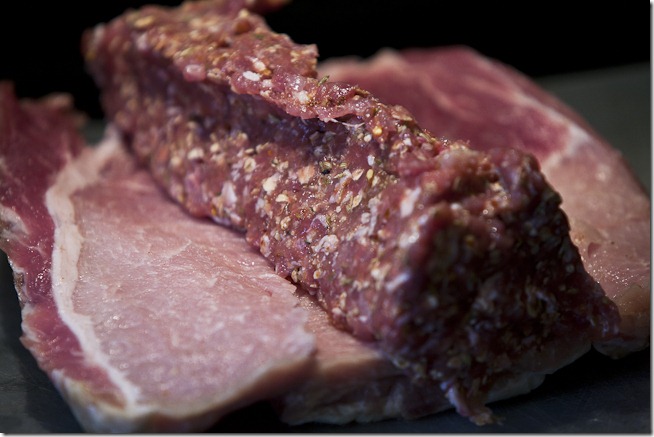
Stuffed Pork Loin

Ingredients

  • 2 to 3 pound pork loin
  • 6 pieces of extra thick hickory smoked bacon (or any bacon you want)
  • 1/2 cup fruit preserves (cherry, raspberry, or blackberry work best)
  • 1/4 cup lemon juice or any fruit juice hanging around in the fridge

Stuffed Pork Loin-1

Directions

Preheat your oven to 350.

Open your pork loin by beginning a cut about 1/2 inch thick, then sort of spiral around until you run out of loin.  The ideas is to transform a cylindrical piece of meat into something flat that we can wrap around the stuffing.  Trust me when I tell you that you will not be happy if you decide to just open it with a cut like a hot dog bun.

Add the sausage (or sausage stuffing) and roll up.  Wrap in bacon and hold the whole thing in place by spearing some toothpicks through the bacon.  Place in the oven on a sheet pan for one hour.

Heat the preserves until thinned (a minute in the microwave will do the trick), and combine with the fruit juice.  After one hour in the oven remove the pork from the oven, and poor 1/2 of the fruit preserve/juice mixture evenly over the top.  Put the pork back in the oven and repeat in 15 minutes.  Put the pork back in the oven for another 15 minutes or until the internal temp has reached 160 degrees F.  Remove from the oven, cover in foil and let rest for 20-30 minutes.
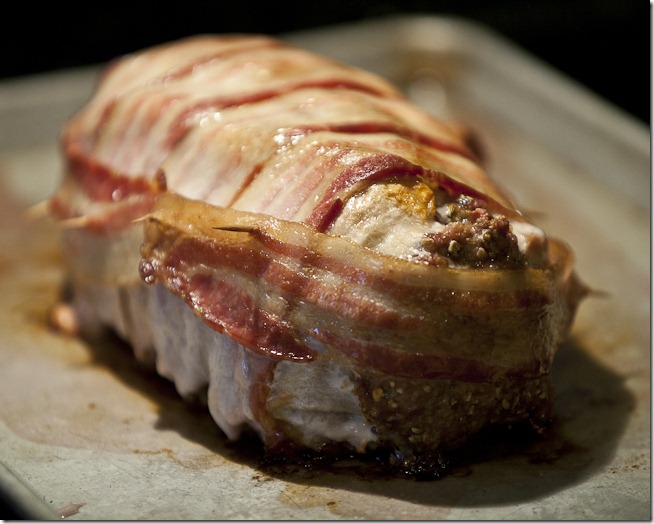
Stuffed Pork Loin-3

Roasted Cauliflower and Onions

Ingredients

  • 1 large head of cauliflower cut into 1/2 inch thick slices
  • 1 large onion sliced thinly
  • 1/4 cup olive oil
  • salt and pepper to taste

Roasted Cauliflower and Onion-2

Directions

Combine all in ingredients in a bowl and toss to evenly coat the cauliflower and onions.  Place your happily bathed veggies on a sheet pan and send off to a preheated oven (400 degrees F) for 20 minutes or until golden brown and tender.  For the menu described in this post, the oven was doing some double duty – at 350 degrees F, it took about 30 minutes for the cauliflower to show some nicely browning edges.

In vino veritas, buen provecho.

Craig

Saturday, March 19, 2011

Taste and Flavor for Food and Wine Pairing

Roasted Cauliflower

The photograph leading off this post is simply gratuitous.  Unlike most posts, this one is more about words than photos.  So if you are just looking for the pretty photographs of great food, you can turn back now.  However, if you want to read about taste and flavor, read on.

My purposes for Craig’s Grape Adventure are several including a great excuse to enjoy great food and wine, explore food and wine pairings I have not yet experienced, uncover the “why” of food and wine pairing that creates a sensation greater than the sum of it’s parts, and of course to enjoy making it all look good through photography. The purpose of this article is to begin discussing our experience of taste and flavor to lay the foundation for understanding why food and wine pairings work – or don’t.

For those of you who already have a solid understanding of this, I apologize – like my good friends who enjoy all the pretty pictures, you too can turn back now. However, among my group of friends and others who have written to me, I know that the understanding of pairings vary dramatically; from those who are eager learners to those who are more skilled than I am. I trust everyone will find a grain of useful information. To begin the discussion I want to focus on taste and flavor. While some argue the distinction between taste and flavor is a matter of splitting hairs, I believe there is good reason to distinguish and hope to make the case here.

We are all aware of the five basic tastes; sweetness, bitterness, sourness, saltiness and the less well understood and more recent acknowledgement in western cuisine – umami. And this story of tastes is a debate that has not yet ended. Consider the flavor of piquance that comes from the Spanish word “picante” which reflects our sensation of spiciness – as in spicy hot – a taste with roots in Chinese, Indian, and Japanese cuisine. Personally, I like the expanded definition of tastes; it gives us more and better ways to describe our experience. For my less than scientific purposes, I will admit all six.

Because umami is less well understood in Western culture, let me take just a moment to talk about it. Umami comes from the Japanese and means a pleasant savory taste. Some research suggests that rather than a distinct taste, umami refers to a distinctive quality or completeness of flavor which in the West we would generally describe as savory or simply delicious. Personally, I generally use it as a declaration of particularly delicious food like a steak fresh off the grill when I exclaim “ooooooh mommy!” Umami is common among proteins, like the NY strip steak I just seared and grilled to perfection, and vegetables – think of ripe tomatoes, eggplant, fish, mushrooms, soy sauce, and spinach. When you think of these foods, you can imagine the mild and pleasing taste that is difficult to describe. Just thinking about it starts the salivation and conjures flavors concentrated in the back of the mouth.

While on the subject of umami, a good question is whether we experience umami in wine. The answer is yes! But unfortunately it is not commonplace. Umami develops in wines that are at the peak of maturity and quality and typically appear in wines that have been treated with extreme care and involve artisanal methods such as barrel or cuve fermentation, malolactic fermentation, extended barrel development, bottling with no filtration, and aging in temperature and humidity controlled cellars. Chances of experiencing umami in wine increase with bottle aged wines in the three to ten year range.

The debate of umami and wine continues to rage – mostly because of the chemical-receptor processes involved (too deep for me!), but I am confident I have experienced it. A recent umami experience with umami in both the wine and the food came with my Ghost Block Cabernet Sauvignon pairing with lamb from the Decanting Napa Valley cookbook. That was a serious ooooh mommy moment. Finally, don’t expect to find umami flavors in young fresh wines. These wines focus on the tastes that generally do not include umami. When it comes to umami and wine, think of mature rather than fresh.

When we experience food, these basic tastes are just the start. Other strong contributors to our experience include smell, texture, temperature and the visual component. I won’t dwell on the visual component, but I am confident we have all had the pleasure of a beautiful dish (or not so much) that affected our expectations and therefore influenced our judgment of the flavor.  Now we get to the hear of the matter; the difference between taste and flavor. Taste refers to the receptors that send a signal to the brain. Flavors are the more complex combination of all these additional components. In other words, when you take your first bite of a perfectly prepared and plated foie gras, the combination of appearance, aroma, texture, taste, and temperature all contribute to your experience and judgment of flavor. It is this integration of the senses that compose the flavor. This helps explain why we describe wine in terms of flavors (fruit, citrus, acidity, earth, fresh, dark, deep, spice, and so on) rather than taste. Another way to think about it is understanding taste as physical (bitter, sour, salty, sweet, umami) and flavor is the sum of our perceptions from all these tastes plus the aroma, texture, temperature, and appearance. Flavor is cognitive – meaning it is the recognition that happens after the taste signals are transmitted. Taste is a finite chemically induced piece of information, while flavor is an infinite mental construct which can also include intangibles of memory and place such as that bite of lobster macaroni and cheese that takes you back fondly to a New England dockside food shack with lobster boats bobbing in the distance.

To wrap up this first installment of the “stuff” that informs our choices of food and wine pairing, the conclusion is that flavors are complex and infinite. The good news is that with an infinite (ok, maybe almost infinite) set of flavors and flavor combinations, we have lots of room for making food and wine pairing an extremely pleasurable experience. In future posts we will look at flavor descriptions, flavor and aroma, and some of the rules of thumb that help us understand why pairings work – or don’t.

In vino veritas, buen provecho.

Craig